Still Water
Quill had three days to decide, and the rest of the party had three days to fill. They spent the first one doing the Duke's work before they had properly agreed to do it — and the first thing they established was that the oath they had sworn him was not magically binding. It held them by their word and nothing else.
Then they split up to look for whoever had broken the stone.
The Warrens, the smith, and the sewers
Thalia still knows the Warrens; she walked a Watch beat here before the Watch let her go for asking too many questions. She took Kaelen to see Errol, a gangly old smith who does more talking than smithing and knows everyone. Had he noticed anything odd around the time of the fog? Not himself — but the Sweepers Guild had. The sweepers keep the flow moving in the sewers under the city, and for a week or two before the fog came, they kept seeing people down there where nobody should be. Not the usual thieves cutting through. More than that, and careful about it.
Errol sent them to Braun, a sweeper who drinks at the Broken Shield — "tell him I said hi, and he owes me five silver." Braun filled in the shape of it over the ale Kaelen bought him: cloaked figures, never more than one or two, in the tunnels in the days before the fog. And two of his own — Old Tom and Billy, who worked the stretch near the Wayfarers' Hall, close to the stone — went missing the night before the mist rolled in. They were written off with the fog's other victims. But they vanished a day too early to be the fog's. Braun said he would ask around the guild and let Thalia know.
So the sabotage had a shape now. Not decay, not an accident — people, on foot, underground, for weeks — and at least two men who might have seen too much were gone before the fog gave everyone else something to blame.
Bowls of water
On the way between taverns Kaelen noticed something the district had started doing: bowls of water set out on stoops, and mirrors — sheets of polished, glossed metal — fixed up beside doors and open windows. They stopped at a bakery to ask. The baker had lost her grandmother's ring; she had happened to have a bowl of water out, and in it she had seen herself, not as she was, but reaching under a piece of furniture — and the ring was there. Then the water had shown her filling a bowl and setting it out, so she had done that too.
Kaelen has fey blood in the family and a Ranger's training, and he read it as fey work — a trade, a something-for-something, the way the Fair Folk do. It troubled him, because by everything he had been taught, the Pact should make that impossible inside the walls.
The boy who came back
Drakov spent his day at the Platinum Basilica, mending people, until Lieutenant Kessa Ironfoot of the Watch came looking for a priest's opinion on something she did not want to bother the High Priest with. She took him down to a Warrens flophouse to meet Ned Tallow, a boy of eight or nine.
Ned and his father had walked into the fog and vanished. A week later the guards found Ned alive by the sewers — hungry, filthy, unharmed. He told Drakov what he remembered: the fog had called him, and in the dark a shining figure had come, "like you," he told the dragonborn — bright, armoured, light pouring off it. It had taken his hand, led him somewhere safe, sat with him, told him everything would be all right, and told him to sleep. When he woke, it was gone and the guards were there. Ned said the figure had a kind voice — like a cat purring. Drakov showed him a drawing of Bahamut, and the boy said yes, that was who had sat with him.
The temple's judgement, from Davian Goldscale on down, was that this was Bahamut, or one of his servants — direct divine intercession, which is vanishingly rare, and which nobody could explain. Least of all why the god had saved the boy and left his father in the dark. Ned's father is still missing.
A house with a red door
That evening each of them found an envelope waiting, sealed with the Duke's crest: an address in Duke's Bridge, nine o'clock. The house has a red door and no name on it. Inside, a tall, black-clad man introduced himself as Ambrose Grieve, the Duke's servant, assigned to this house — and the house, he told them, was now theirs for as long as they served. A key each, not to be lost or given away. Fifty gold a month. A place to sleep and a place to leave messages. Quill, who had agreed to nothing and was not there, got no key.
What the water showed Kaelen
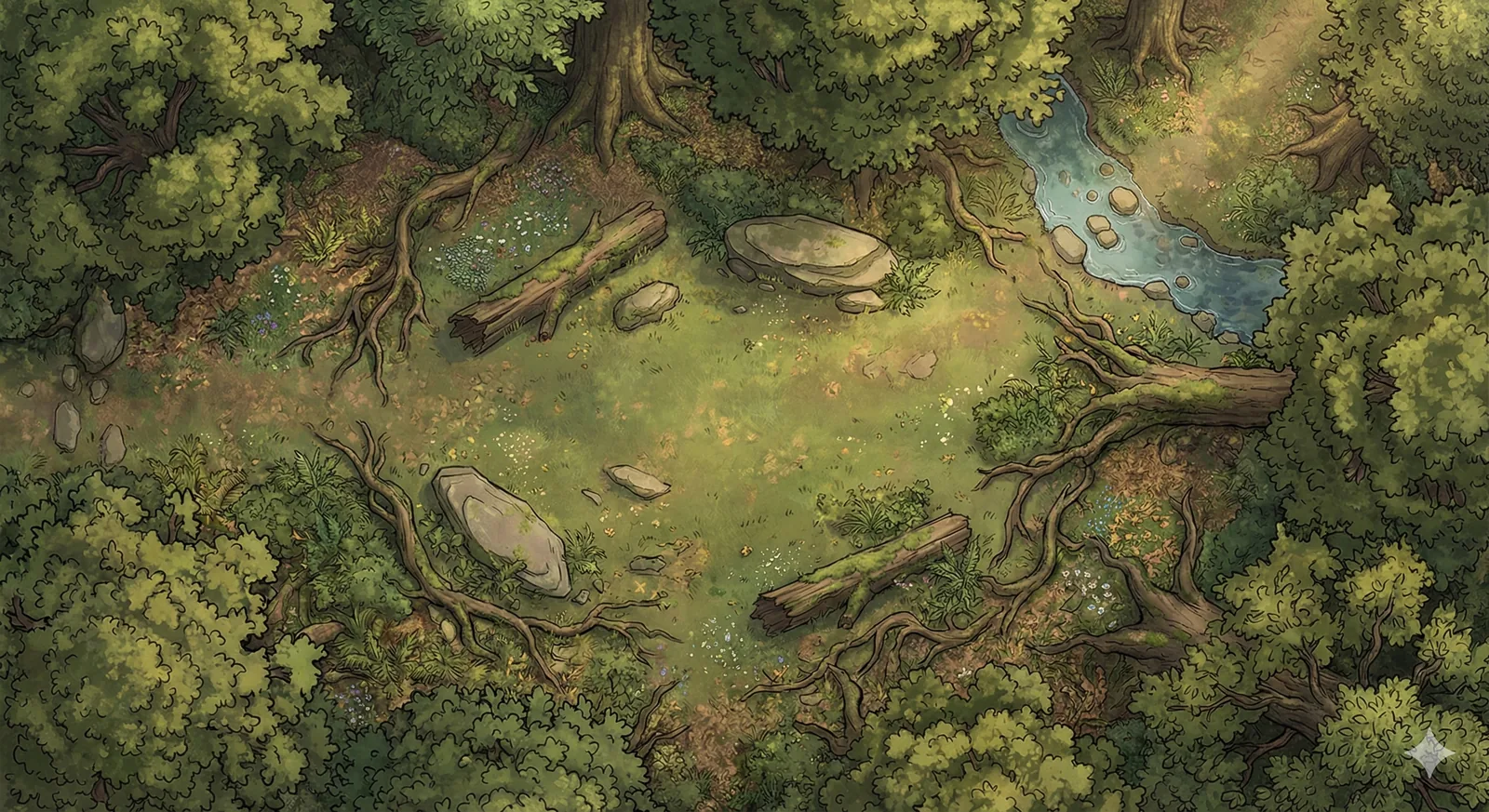 Kaelen could not sleep. He went back out into the Warrens at night to watch the bowls and the
mirrors, and one of them showed him something. A pane that should have caught the
streetlamp caught trees instead — great trunks, a clearing seen from a branch above it. In the
clearing, in a green ranger's cloak, with a bow beside him and salt-and-pepper in his beard,
a man lay asleep. Kaelen knew him. It was Edran Holloway — Mira's lost mentor, the man
whose medallion he now wears — and the moon in the vision was the same moon hanging over
Kaelen's head.
Kaelen could not sleep. He went back out into the Warrens at night to watch the bowls and the
mirrors, and one of them showed him something. A pane that should have caught the
streetlamp caught trees instead — great trunks, a clearing seen from a branch above it. In the
clearing, in a green ranger's cloak, with a bow beside him and salt-and-pepper in his beard,
a man lay asleep. Kaelen knew him. It was Edran Holloway — Mira's lost mentor, the man
whose medallion he now wears — and the moon in the vision was the same moon hanging over
Kaelen's head.
Then the clearing was gone, and it was only Kaelen in the street — except that his reflection reached into his pocket and drew out something that was not in his pocket, and hooked it to his armour, and was gone.
He told no one. He went home to a house that was not quite his yet, and kept it to himself.